
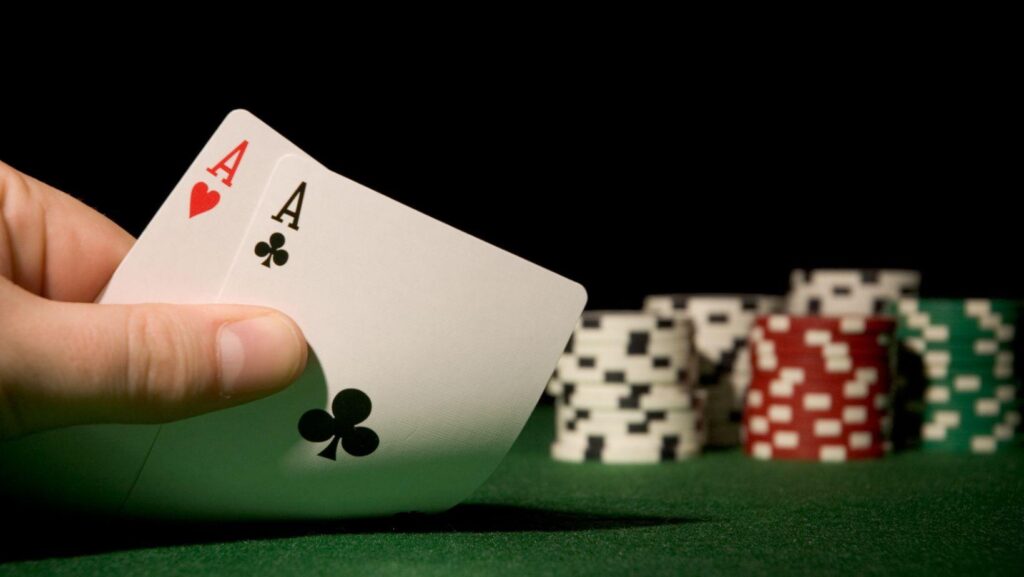
A growing cohort of competitive athletes across Canada, the UK, Brazil, and Latin America are borrowing training frameworks straight from the poker table. Coaches are integrating structured incomplete-information drills into pre-season programmes, and the results are showing up in faster in-game adaptation and sharper reads on opponents.
Why Poker, Why Now
Traditional sports psychology leans on visualization, breathing routines, and pre-performance rituals. Those tools still matter. But they don’t systematically train what modern sport demands most: rapid, probabilistic decisions under cognitive load with incomplete information.
Poker does exactly that on every hand. A player must assign rough probabilities to an opponent’s range, size a bet relative to the pot, and execute before the window closes.
That maps cleanly onto a basketball point guard reading a collapsing defence, a football striker deciding whether a run is on, or a rugby fly-half scanning the line in two seconds.
Poker training develops exceptional observation skills and fast decision-making ability that transfer directly to competitive contexts. It also teaches players to recognize good bets and act on incomplete information – the exact competency a defender needs when an attacker’s next move is ambiguous.
The Core Frameworks Athletes Are Adopting
Opponent Modelling
In poker, experienced players don’t react to a single bet – they update a running model of how an opponent has behaved across multiple streets.
Athletes are applying the same habit in film sessions: instead of cataloguing one opponent action, they build tendency profiles across multiple game situations. A winger who cuts inside most of the time when the full-back is tight becomes a probability, not a surprise.
Bet-Sizing as Decision Calibration
Bet-sizing in poker is a precision exercise. A 30-chip bet into a 90-chip pot carries different information and risk than a 70-chip bet into the same pot.
Coaches are using analogous drills: athletes assign a confidence score – low, medium, or high – to each decision option in a simulated scenario, then justify it. Quantifying conviction compresses reaction time because the mental framework is already in place.
Flow State as a Trainable Target
Flow states in poker – where decisions come faster and outside noise stops registering – mirror the peak performance conditions athletes seek in competition.
The key insight: flow isn’t just something that happens to you. It’s a state you can approach by reducing decision friction. Athletes practising incomplete-information drills under time pressure rehearse the cognitive conditions that produce flow, making it more accessible on match day.
Putting It Into Practice: A Sample Drill
One drill gaining traction with Canadian junior hockey and Brazilian futsal academies works like this:
● Scenario card: A coach presents a game situation with deliberately missing information (opponent positioning unknown, score ambiguous).
● Range assignment: The athlete lists three possible opponent actions and assigns a rough probability to each – no precision needed, just a forced estimate.
● Decision with justification: The athlete commits to a response in under three seconds and states the reasoning aloud.
● Debrief: The group reviews whether the probability assignments were reasonable and
whether the decision matched the most likely scenario.
The drill mirrors a poker player working through hand ranges before committing chips. Athletes used to instinct-based training often resist the quantification step at first. Repeated exposure builds a mental shorthand that speeds up real-game processing.
The Social Dimension: Reading Teammates as Opponents
Poker is a masterclass in strategic communication – conveying intentions while simultaneously reading others. The same observational habits used to model opponents also sharpen intra-team reads.
A midfielder who can predict a striker’s run tendency is more useful than one who simply reacts. Playing poker with friends in a structured training context builds exactly this dual awareness: you’re always both broadcasting and receiving information.
Poker also strengthens emotional intelligence and decision-making under pressure – a direct benefit for athletes managing the psychological load of close competition.
Getting Actual Table Reps
Classroom drills only go so far. Real opponents introduce variance that simulated cards can’t replicate.
Coaches increasingly recommend live table sessions as a complement. Fast-fold formats – where each hand resolves quickly and a new decision arrives immediately – are particularly useful for compressing volume.
For athletes experimenting with Bitcoin poker or other crypto-friendly deposit options, GGPoker’s Rush & Cash format delivers that rapid-fire decision loop across a large global player pool, making it easy to log high decision volume in a short session.
Where This Is Heading
Sports science has spent decades quantifying physical performance. The next frontier is decision-speed under uncertainty, and poker’s training architecture is one of the most structured tools available for developing it.
Academies in São Paulo, Buenos Aires, and Toronto are already running pilot programmes. Expect the methodology to spread as results filter through to coaching networks.
The core insight is simple: train an athlete to quantify uncertainty, model opponent tendencies, and execute in a compressed window at the poker table, and those same neural pathways fire when the game is on the line. The table is just the training ground.